Malawi’s improving macro economic indicators are yet to translate into better conditions at the dinner table with new World Bank data showing that more people cannot afford minimum food requirements despite declining overall poverty and moderating inflation.
The World Bank’s latest Malawi Economic Monitor (MEM) indicates that national poverty has fallen from 50.7 percent to 47.3 percent between the 2019/20 and 2024/25 while food poverty rose from 20.5 percent to 24 percent.
During the period, according to the report, inequality also increased, with the Gini coefficient rising from 37.9 to 39.9, suggesting that improvements in welfare have not been evenly distributed.
Gini coefficient measures of inequality, ranging from zero, which is perfect equality to one representing maximum inequality, commonly used to assess income or wealth distribution within a population
The report summarises the apparent paradox: “Welfare gains were modest, uneven and accompanied by more widespread and deeper food hardship.”
The figures mean that while a smaller proportion of Malawians were classified as poor overall, a larger proportion could not afford the minimum food basket used to determine the food-poverty threshold.
The Bretton Woods institution explains that the two movements are not statistically contradictory. The
proportion of people who were below the overall poverty line, but above the food-poverty line contracted from 30.3 percent to 23.2 percent.
At the same time, the food component increased from 61.1 percent to 68.5 percent of the minimum basic-needs benchmark, indicating that meeting minimum food requirements was absorbing a greater share of the resources required to satisfy basic needs.
More significantly, the food-poverty gap, the measure of how far food-poor households fall below the threshold, increased from 4.8 percent to 6.4 percent.
This suggests food deprivation became not only more widespread, but deeper among affected households.
Mzuzu University economics lecturer Christopher Mbukwa said in an interview on Tuesday that the numbers could reflect an uneven recovery in which some households near the overall poverty threshold improved while conditions deteriorated among those at the bottom.
He said national inflation figures could also conceal sharp increases in essential staples and geographical differences in food prices.
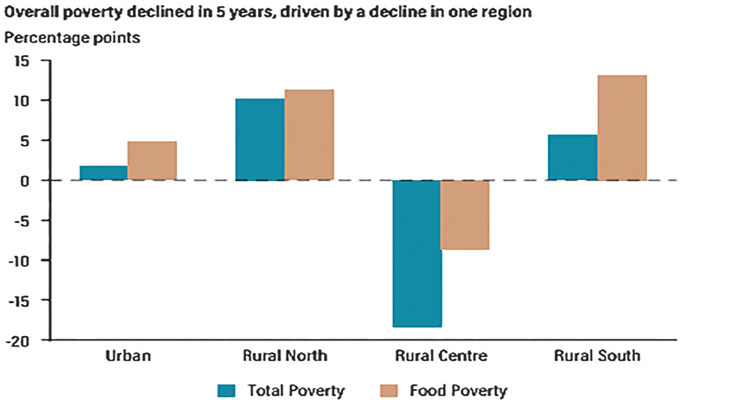
That interpretation is consistent with the MEM’s regional findings. The report indicates that rural areas in the Central Region, which accounts for more than a third of the population, drove much of the decline in national poverty while conditions deteriorated in rural areas in